Privacy Blocks Hide 30–40% of Your Real Conversions. Here's How to Get Them Back.
iOS, ad blockers, and cookie consent banners don't stop sales — they stop measurement. Here's how much you're missing and what to do about it.
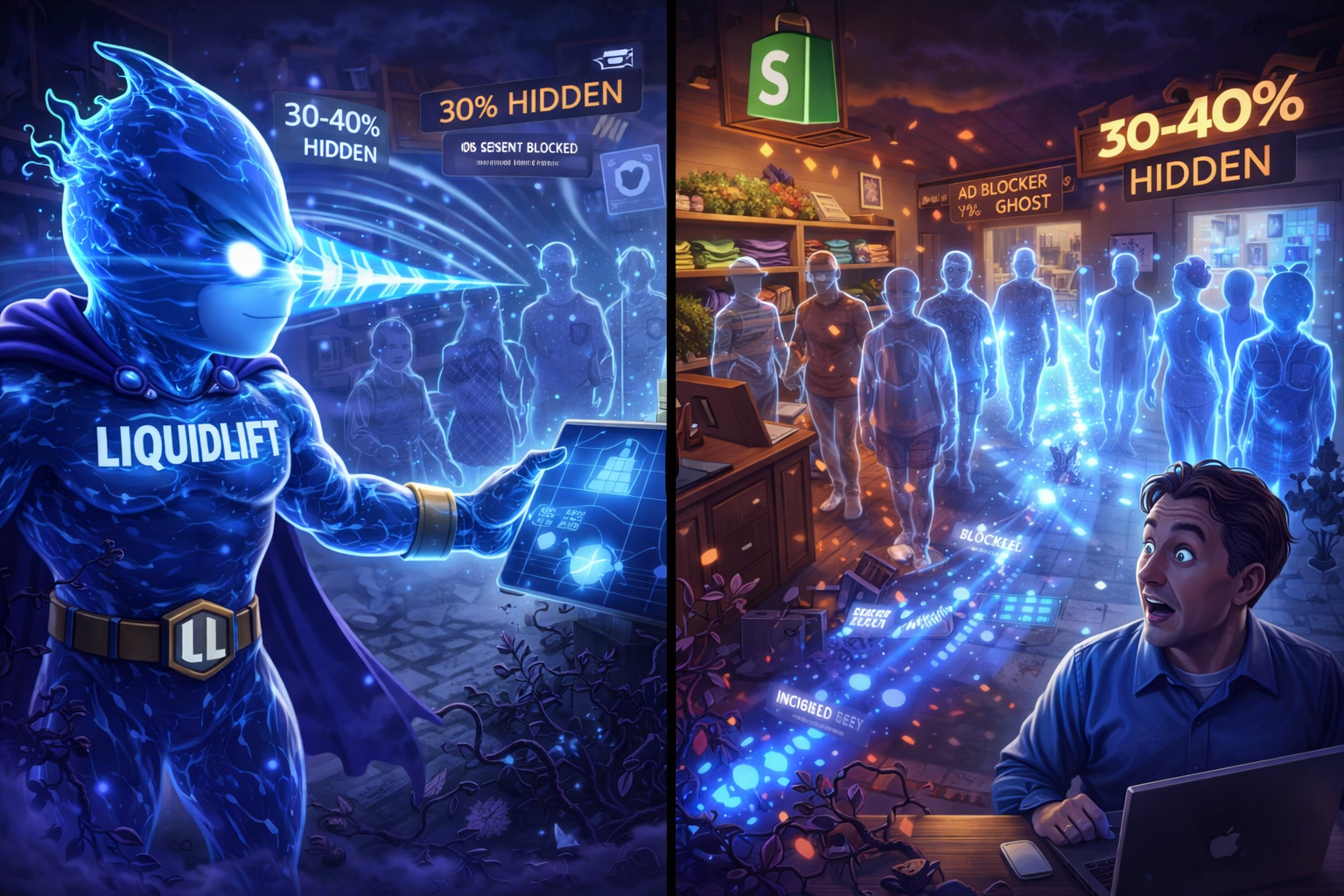
A Shopify merchant posted in r/PPC last week: "Shopify only recorded 60% of conversions over 12 months. Are my ads actually doing better than what I'm seeing?"
Yes. Almost certainly yes.
And he's not alone. If you're running a Shopify store with paid traffic — especially with European customers — your dashboards are lying to you by omission. Not because the tools are broken, but because privacy infrastructure is doing exactly what it was designed to do: block tracking.
The three layers hiding your conversions
Layer 1: iOS App Tracking Transparency
Since iOS 14.5, Apple asks users: "Allow this app to track your activity across other companies' apps and websites?" Roughly 75% say no.
When they say no, Meta's pixel can't identify them. Their purchase, their add-to-cart, their entire journey — invisible to your ad platform. The sale still happens. Shopify still processes the order. But Meta never finds out, so it can't learn from it or optimise towards similar buyers.
Layer 2: Ad blockers
Around 30% of desktop users run ad blockers. These don't just block ads — they block tracking scripts. Your Meta pixel, your Google tag, your analytics JavaScript — all prevented from loading.
The visitor browses your store, adds to cart, completes checkout. Your server processes the order. But the pixel never fired, so as far as Meta knows, that visitor bounced.
Layer 3: Cookie consent (GDPR/ePrivacy)
If you sell to EU customers, you're required to show a cookie consent banner. Visitors who decline — or simply close the banner without accepting — can't be tracked.
One merchant asked: "I have cookies so I assume that is why results are lower. I wonder whether this affects my ads performance negatively."
It does. Not because the consent banner stops people from buying — it stops the pixel from seeing that they bought. And when Meta can't see conversions, it can't optimise. Your CPA rises, your ROAS drops, and you blame the ads when the real problem is measurement.
The maths of signal loss
Let's say your store does 1,000 real purchases in a month.
- iOS blocks ~35% of those from pixel tracking: 350 invisible
- Ad blockers hide another ~15%: 150 invisible
- Cookie consent refusal (EU traffic) hides ~10%: 100 invisible
After overlap adjustment, roughly 400 of your 1,000 purchases are invisible to Meta. Your pixel reports 600 conversions. Your actual number is 1,000.
Meta's algorithm optimises based on those 600 visible conversions. It thinks it knows your best audience, your best creative, your best time of day — but it's working with 60% of the picture. Every optimisation decision is compromised.
How to recover the invisible 40%
The fix isn't turning off consent banners or asking users to disable ad blockers. The fix is changing where tracking happens.
Move tracking server-side
Browser-based tracking (pixels) can be blocked. Server-side tracking (CAPI) can't — because it runs on your server, not in the visitor's browser.
When someone completes a purchase on Shopify, your server already knows about it. Server-side tracking takes that data — order value, customer email hash, transaction ID — and sends it directly to Meta. No pixel involved. No browser involved. No blocker can intercept it.
Improve Event Match Quality
Meta uses Event Match Quality (EMQ) to score how well it can match your server-side events to real Meta users. Higher EMQ means Meta can identify more of your customers and attribute more conversions.
The key parameters that improve EMQ:
- Hashed email — the single most impactful identifier
- Phone number (hashed)
- fbp/fbc cookies — when available from consented users
- IP address and user agent — for probabilistic matching
A store with EMQ of 3 might recover 10% of lost conversions. A store with EMQ of 8+ recovers most of them.
Deduplicate properly
When you run both pixel and server-side tracking, some conversions get counted twice. Proper deduplication — using a shared event ID — ensures each conversion is counted exactly once. Without it, you swap under-reporting for over-reporting.
What this means for your ads
When you recover even half of those hidden conversions, the impact cascades:
- Meta sees more data → better audience modelling
- Better audience modelling → ads shown to higher-intent users
- Higher-intent users → higher conversion rates
- Higher conversion rates → lower CPA
- Lower CPA → higher ROAS at the same spend
The stores complaining about "Meta ads feeling broken" in 2026 are often the stores with the worst signal loss. Their ads aren't broken. Their tracking is.
Fix the tracking, and the ads fix themselves.
Free audit
Find out what your tracking is missing.
Join the waitlist and get a free Revenue Leak Audit — we'll analyse your store's tracking setup, attribution gaps, and signal loss.
Get my free audit →